Atlantic Health
Using message testing to uncover what physicians actually needed to trust a new treatment
Atlantic Health had just made a major investment in proton therapy. It needed a small, skeptical audience of referring physicians to believe in it and change what they did next.
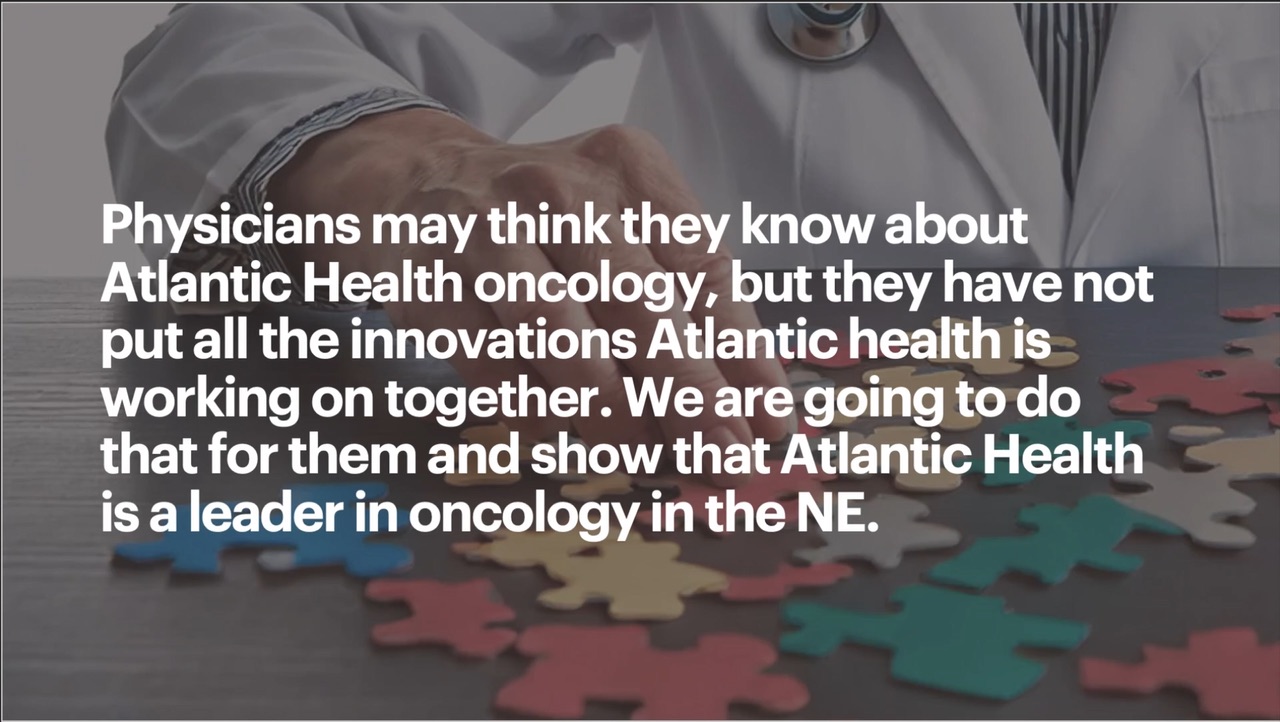
Atlantic Health invested $65 million in a state-of-the-art upright proton therapy center — technology that treats cancer with submillimeter precision while patients sit upright. But the physicians who would refer patients weren't referring.
I led qualitative and quantitative research to understand why, then developed and tested the messaging strategy that fixed it. The final framework was adopted across physician-facing email campaigns, landing pages, and future advertising.
Executive summary
Physicians didn't understand why upright treatment mattered clinically
The center's early messaging led with innovation and patient comfort. Physicians heard it — and filed upright positioning away as a comfort feature rather than a clinical advantage. Comfort doesn't drive referrals; clinical outcomes do.
The strategic shift: stop selling leadership and comfort, and directly connect upright positioning to measurable clinical outcomes — precision, reduced motion, protected healthy tissue.
Phase 01
Qualitative interviews: locating the gap
Goal: understand how physicians interpreted the proton therapy system, to sharpen the quantitative survey before testing nationally.
I needed to understand how physicians currently evaluated proton therapy providers, what made messaging feel clinically credible, and whether they understood the clinical value of upright positioning — in order to define referral decision-making patterns, trust drivers and skepticism triggers, reactions to early messaging concepts, and gaps in understanding around upright treatment.
“Physicians understood upright positioning as a comfort feature rather than a clinical advantage.”
The insight that shaped the entire messaging strategy
Phase 02
Quantitative message testing: 15+ messages, four dimensions
I developed and tested more than fifteen messages, first refined through the qualitative findings, then measured nationally on clarity, credibility, differentiation, and referral impact.
Updated messaging outperformed broad leadership language across all measured dimensions. The pattern was consistent: specificity won. Numbers beat adjectives; mechanisms beat mission statements.
Before
Cancer Treatment, Redefined by Precision
Experience unmatched accuracy and comfort with advanced upright proton therapy.
Leading the Next Generation of Proton Therapy
Atlantic Health combines clinical accuracy and patient comfort with breakthrough technology.
Why they underperformed
Too broad · lacked specificity · reduced perceived rigor · interchangeable with competitors
After — tested winners
Better Outcomes Begin with Greater Precision
Upright proton therapy uses submillimeter targeting and real-time imaging to deliver unmatched accuracy.
Specific · measurable · clinically credible
Up to 50% Less Lung Motion
Upright positioning reduces breathing motion and increases lung volume for lung and chest cancers.
Directly connects upright positioning to measurable treatment precision
Fewer Side Effects Through Precise Targeting
Proton therapy stops exactly where the cancer ends so healthy cells stay protected.
Clear clinical value tied to physician referral priorities
The work in market
From research deck to running campaign
The final messaging framework was adopted across physician-facing creative — email campaigns, landing pages, and future advertising. The motion piece below carries the tested language into the brand's visual system.
Tested language, shipped: the campaign motion graphic built on the winning messages.
Reflection
The words are part of the product
A $65M facility with best-in-class technology was invisible to its audience because of a framing error — comfort versus clinical value. Research found the gap, testing proved the fix, and referral intent doubled without changing anything about the product itself.
It's the same lesson I keep re-learning across brand and product work: before you redesign a product, check whether people understand what the product is.