ROLEUX Designer
Spotify Mix
Helping listeners understand Spotify's mixing recommendations.
Spotify Mix helps listeners create smoother transitions between songs using tools like Smart Reorder, BPM matching, and key compatibility.
The project focused on making Spotify's recommendations easier to understand through clearer guidance, contextual education, and more visible feedback.
TIMELINE2026
WEBSITEMobile App
METHODSQual + Quant Survey · Moderated testing · Confidence scoring
T H E P R O B L E M
Creating smooth transitions required knowledge most listeners didn't have
Spotify Mix helps listeners create smoother transitions between songs, but many of the decisions required an understanding of concepts like BPM, key compatibility, and transition quality.
While users understood the outcome they wanted, many struggled to understand Spotify's recommendations or determine what action to take next.
Research Highlights
Survey
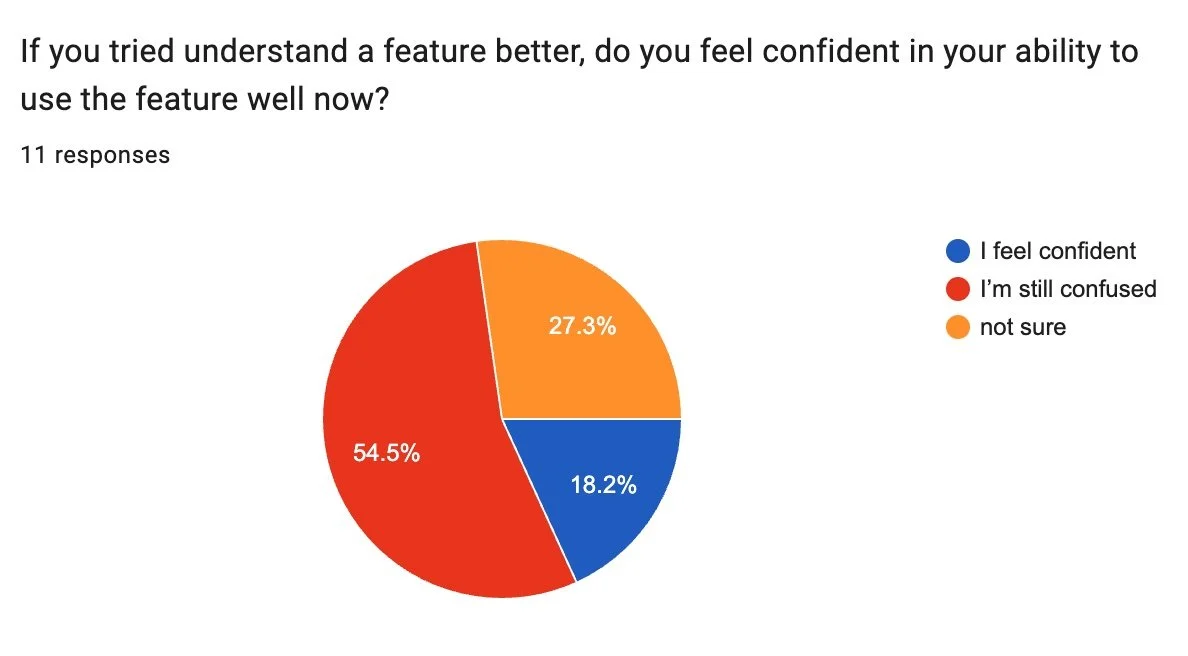
9 of 11 respondents who tried to learn the feature still felt confused or uncertain afterward
Most respondents reported little or no familiarity with mixing terminology
Usability Testing
Multiple participants didn’t realize Spotify had a Smart Reorder immediately after feeling confident that they had just looked through the full feature
Participants frequently looked for explanations when encountering unfamiliar concepts
T H E O P P O R T U N I T Y
Making mixing more approachable
The redesign focused on reducing cognitive load throughout the workflow by providing guidance when users needed it, simplifying decisions, and helping users make progress with confidence.
We really need two things to mix.
The transitions to sound good
The order of the songs to flow so that we can mix the transitions well
These were the two moments I aimed simplify first.
T H E F O U N D A T I O N
Simplifying transition editing
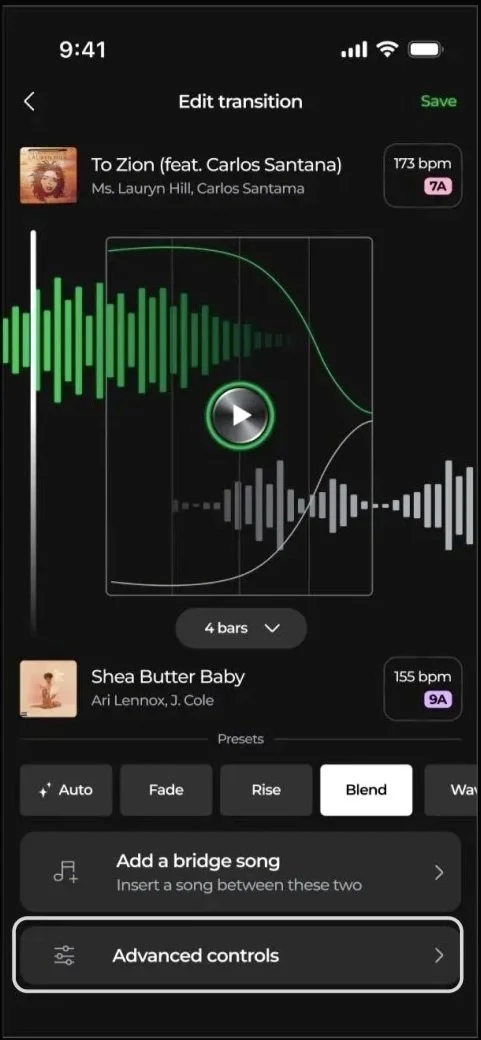
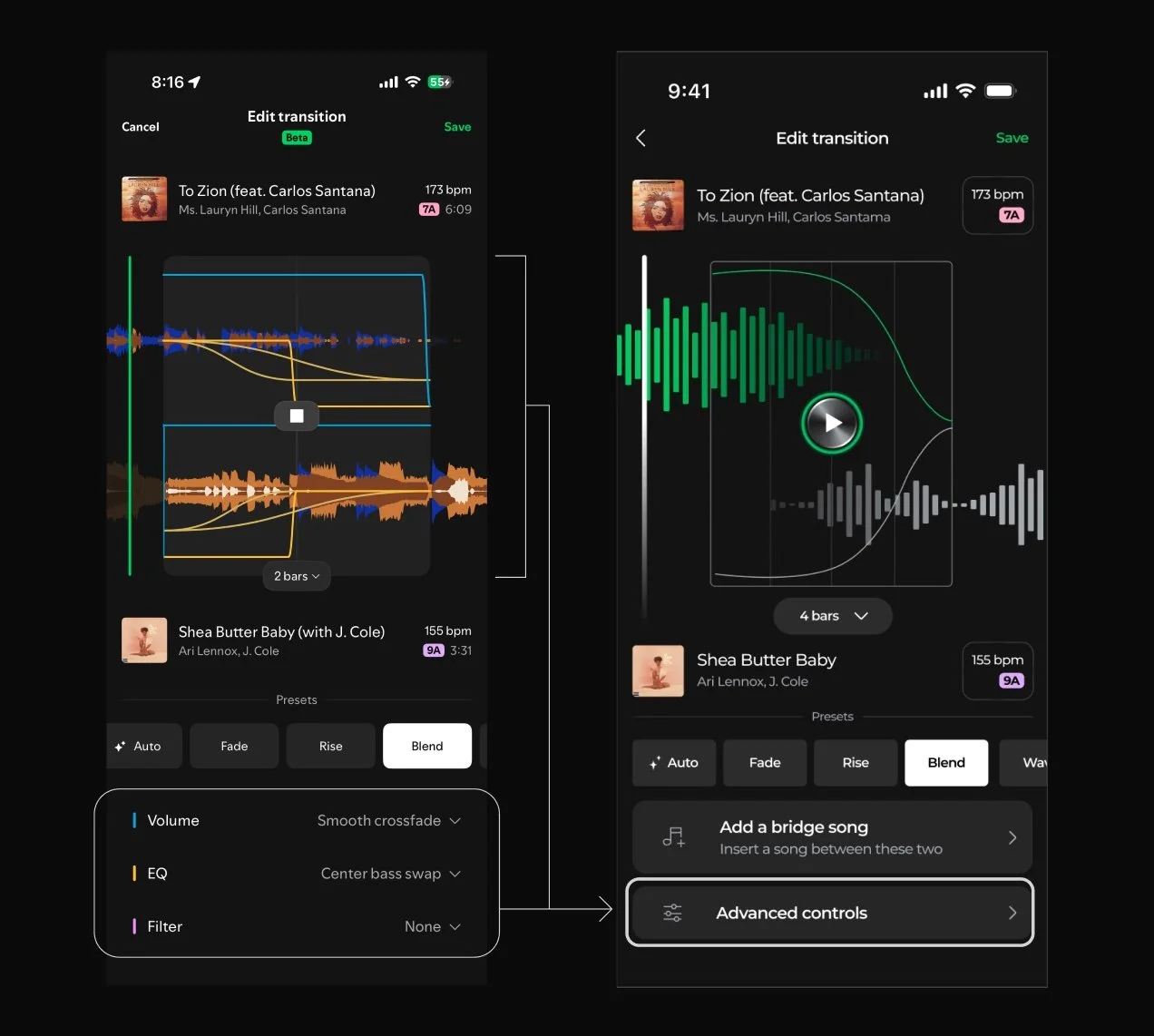
Many participants reported limited familiarity with mixing terminology and primarily used presets when creating transitions. The redesign focused the editing experience on transition decisions while keeping advanced controls accessible for users who wanted more control.
T H E F O U N D A T I O N
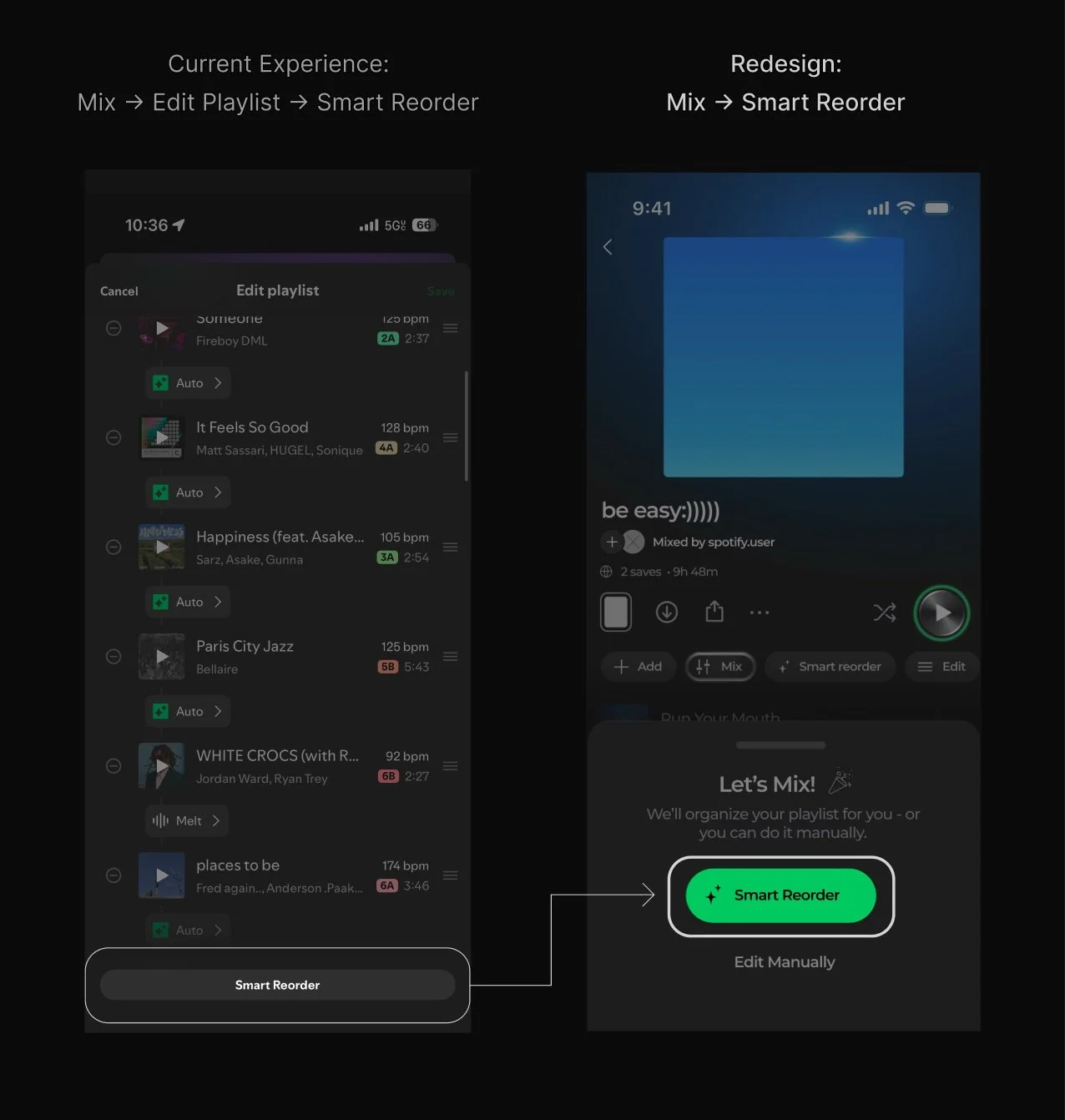
Bringing Smart Reorder forward
During usability testing, multiple participants didn't realize Spotify already included Smart Reorder—even after feeling confident they had explored the feature.
They complimented the redesign for including it.
The redesign moves playlist optimization closer to the start of the workflow with Smart Reorder.
This decision focused on improving access to an existing capability rather than introducing new functionality.
E D U C A T I O N
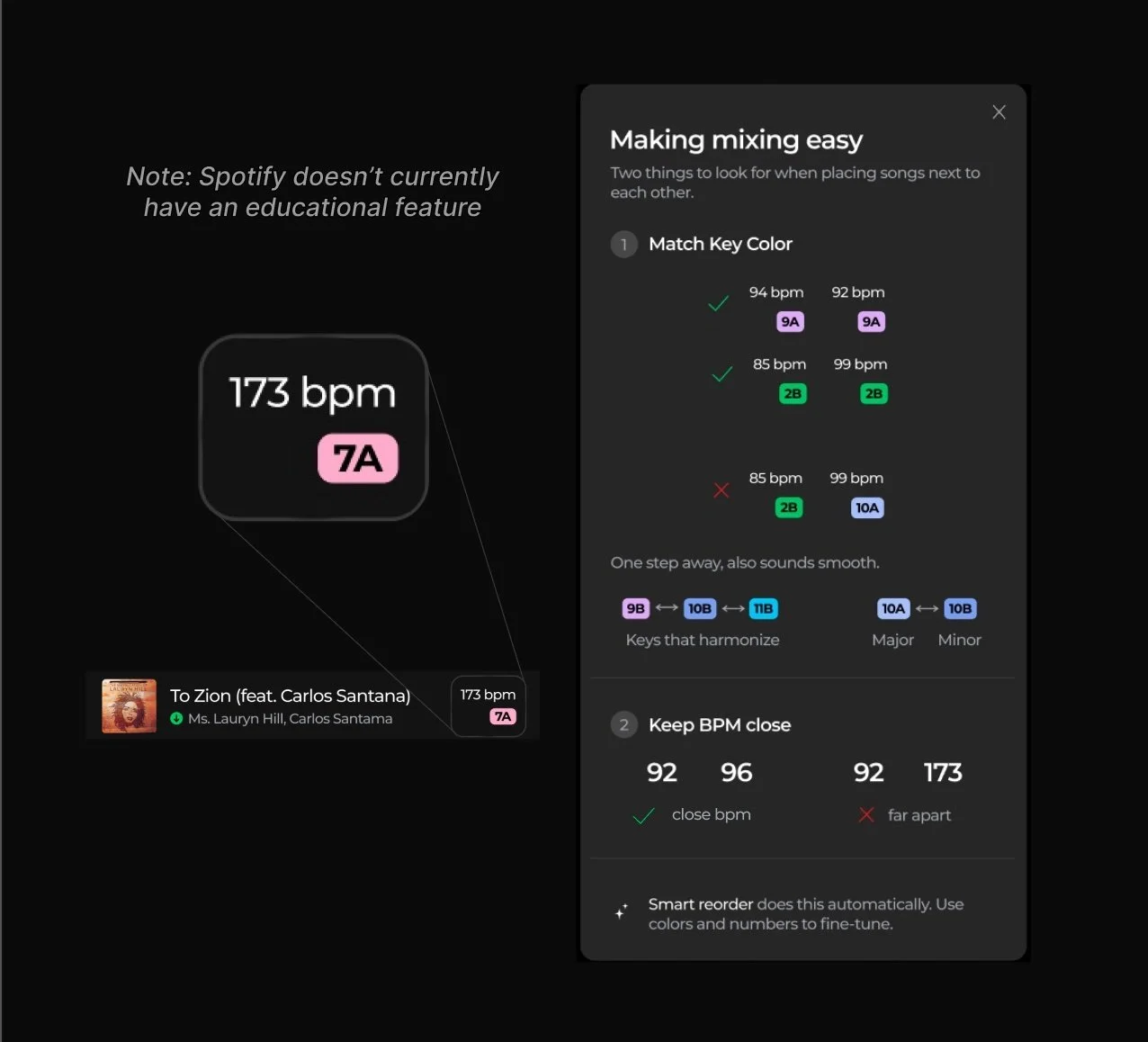
Tap to learn more

Simplifying the experience reduced friction to mix, but one challenge remained: some decisions still required a basic understanding of concepts like BPM and key compatibility.
Not every listener wanted that level of control. Some participants preferred Spotify to handle the decisions for them, while others wanted to understand why recommendations were being made and how transitions could be improved.
The redesign introduced contextual explanations that could be accessed when needed, allowing users to learn without interrupting the workflow.
T R A D E O F F N A V I G A T I O N
Connecting problems to solutions
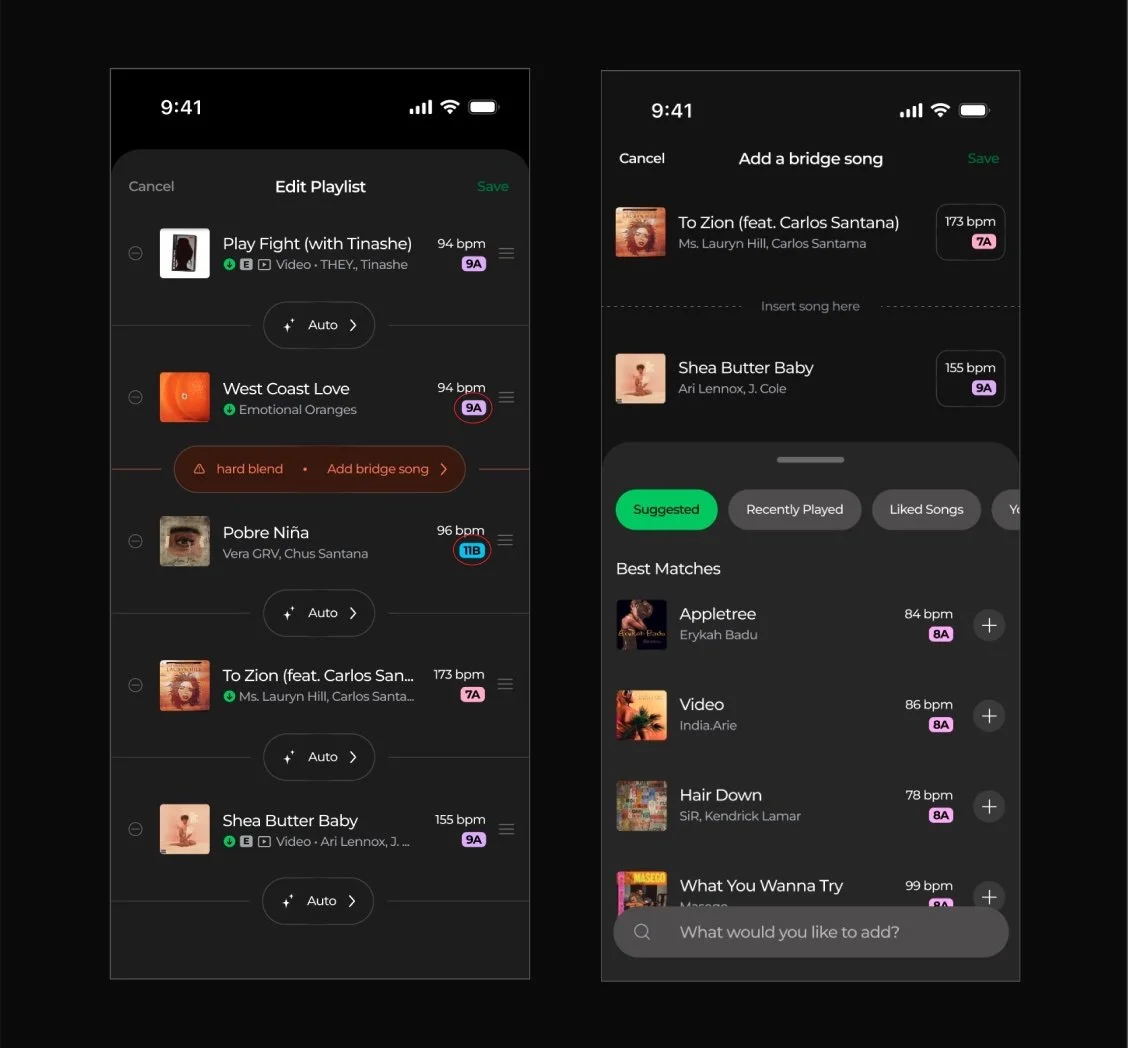
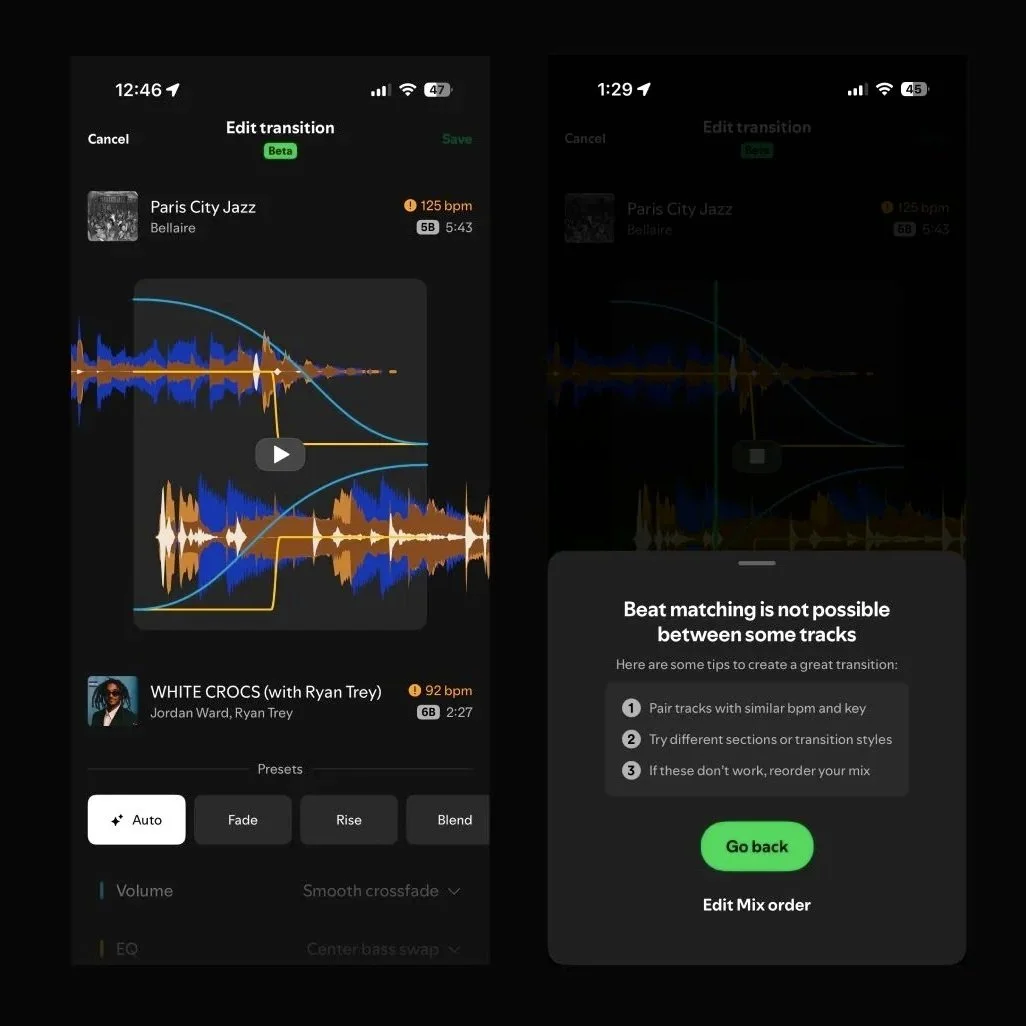
Spotify could identify when a transition was unlikely to work well, but the guidance often stopped at explaining that a problem existed.
The redesign surfaces problematic transitions directly within the playlist and provides users with potential ways to improve them, reducing the effort required to move from diagnosis to action.
Spotify’s Current Experience:
The Redesign
"This is not as helpful…This is very minimal in what it's telling you. For me, it would be kind of useless. And I have to try to figure it out on my own."
— R4 Usability Test Participant
Directly labeled actions.
O U T C O M E S
Participants reported greater confidence using the redesigned experience
Across usability testing, participants consistently rated the redesign higher than Spotify's current experience for confidence and understanding.
Highlights
Average confidence rating increased from 2.6 to 3.7 out of 5
Every participant preferred the redesign over Spotify's current experience
Participants successfully applied BPM and key concepts after receiving contextual explanations
R E F L E C T I O N
This project reinforced the importance of designing for different levels of involvement
Some participants wanted Spotify to handle mixing decisions for them. Others wanted enough context to understand recommendations and make adjustments themselves. Designing for both groups required more than simplifying the interface—it required providing guidance without making it mandatory.
Next Project
( Message Testing )
RESEARCH
Building Trust in Oncology Referrals
Why do physicians choose one oncology provider over another? Through interviews and survey research, I uncovered key drivers of referral behavior and helped shape messaging that built trust and credibility.